
Riverlogue

This blog originates on the banks of the Atchafalaya River, in Louisiana. It proposes to share the things that happen on and by the river as the seasons progress. As the river changes from quiet, warm, slow flow to rises of eighteen feet or more, there are changes in the lives of the birds, fish, amphibians and reptiles that use the river. And the mood of the river changes with the seasons. I propose to note and comment on these things.

My Photo
Name: Jim Delahoussaye
Location: Butte La Rose, Louisiana, United States

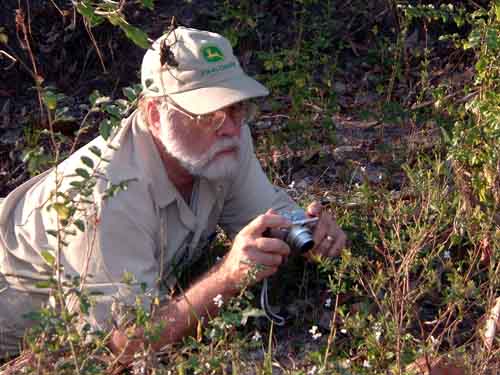
I transitioned a few years ago from a career as a water-pollution control biologist. I want to do this blog to stay in touch with a world outside my everyday surroundings, whatever they may be. I like open-minded company and the discussion of ideas. Photo by Brad Moon.

Wednesday, May 07, 2008

Twenty Feet


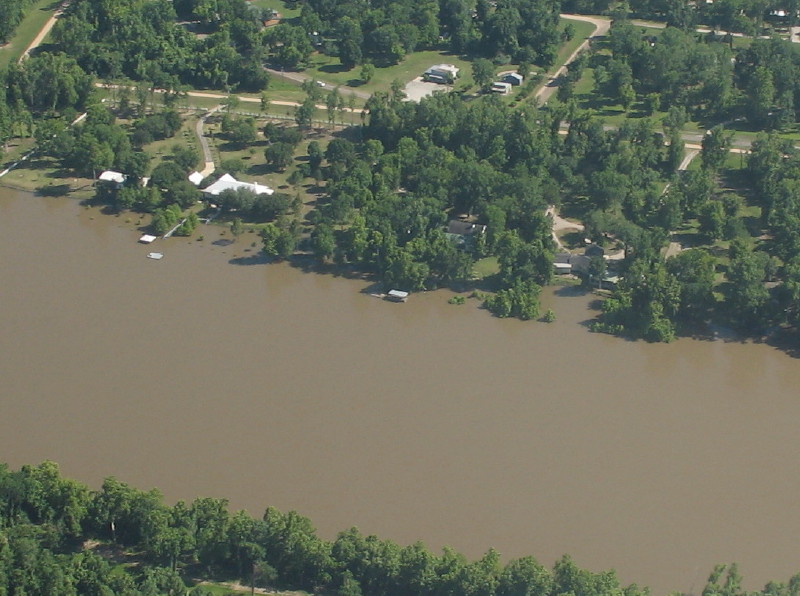
Twenty feet. That's how much water it took to cover our dock to this extent. This was the high point, reached last week. There is about four inches of silt on the deck where I'm standing. So far nothing has been damaged, and I do get a kick out of catching various fishes in water covering lawn that I usually have to mow once a week. During the height of the water I caught channel cat, blue cat, goujon, eels, barfish and shortnose gars on a tightline stretched from the walkway to a stake I drove into the ground. Much fun.
The river is at 18.4 right now on the Butte La Rose gauge, falling to 17.4 by next Monday. The Mississippi and Ohio are both falling so this rise is fated to fade out gradually. More could come, but it would have to be new rain.
Rise and Shine, Jim

Thursday, May 01, 2008

Just a Hummer

Sometimes things just hit you as being outstanding! This ruby throated hummingbird is such a thing. He joins several dozen of his kin trying hard to drain our feeders at a rate that will guarantee a good market for sugar for a long time. The females are showing rounded bellies that hide one or two eggs ready for laying. People ask about the possessiveness that some of these little birds exhibit. If there are four or five trying to use the feeder at the same time, the aggressive ones just seem to give up. “Oh well” almost fits the situation.

The river at the Butte La Rose gauge reads 19.7 feet right now, falling to 18.5 by the beginning of next week. The Mississippi and Ohio are both falling so there is no prediction for another big rise at this time. I’m still catching nice catfish on the lawn. The river has claimed two of my big shrimp traps. I have no complaints.

Rise and Shine, Jim

Friday, April 18, 2008

Wood Duck Thoughts


What is the difference between a thing and the idea of that thing? When we look at the picture of a wood duck, a close-up picture, one that fills the frame with the wonderful colors and feather patterns, what do we mostly think? Most of us think that this is a pretty duck, a very pretty duck that makes us wonder that it could be so colorful, and so finely detailed in every way. It is the structure we think of – the physical being of the wood duck.

I suggest that there is another way to look at wood ducks. It is the idea of wood ducks, rather than the reality of them. When you stand out on the river at first daylight, they fly up and down the river – sometimes landing in a tall tree, sometimes just swooping low to the water and then high over the trees – always making that wheep-wheep call that so much identifies them. At times like that you can believe in the idea of something that otherwise we think of only in physical terms.

When they fly together in small groups of four or five you can get the feeling of the wonder of flying. The idea of flight is so alien to us because we cannot do it, but it is so natural to those that are equipped for it. Freedom comes to mind when we see them fly. Freedom is an idea, a thought, not physical.

When ducks sail they can be making their final decision as a living being in duck form. Sailing ducks have a particular meaning for those who think ahead to rice and gravy. If they are sailing toward decoys, a hunter is experiencing that rush of emotional energy that precedes a successful conclusion to his efforts. Food comes to mind at that moment. The idea of food and that feeling of contentment following a good meal are ways to think of the wood ducks sailing.

As they land up in the trees, the ducks fly in the face of all we are taught to believe about ducks. Ducks land in water, not in trees. Except that wood ducks do land in trees. So the idea that these are different from the ordinary comes to mind, these animals that deviate from expectations. So maybe it’s ok to be different, we think. The idea of difference being something to be glad for is an idea that wood ducks bring to us, I think.

When the resting ducks find a place in thick branches they can be hard to locate. They can represent elusive beauty, or the idea of something worthwhile that we must hunt for instead of having it thrust into our awareness like a loud unexpected noise. That kind of beauty is often more satisfying because it is we as individuals who found it. Not having to share it with the crowd makes some things more special, somehow. Finding two wood ducks in a thickness of tree branches can be that kind of experience.

And then sometimes the wood ducks just stand up on top of the tallest dead willow tree they can find and announce themselves to the world. It is easy to see this and think of the ultimate grace in our relationship with wild things. The ultimate grace in knowing that there is something special up there in that dead willow tree, and we have been given the chance to appreciate it. The fact that we can look and smile at this indistinct image , knowing that the ducks are just as meaningful to us as they were in the close-up image I spoke about before, is what I mean by the idea of something.

The river is at 19.8 feet on the Butte La Rose gauge, rising to 20 feet by the 22nd. This is the highest it has been since we moved here in 1999. I have set out a tightline over what was our lawn – caught three catfish where I normally cut grass. The Ohio and Mississippi are both falling above Vicksburg so things should level out next week, and maybe start to fall after that.

Rise and Shine, Jim

Thursday, April 10, 2008

The Eighth Line, and Floods

Beyond ownership;
A place where a great river lives;
Where most of our crawfish used to come from;
Where commercial fishermen make a living;
A place of memories for a lot of people;
A home for ghost stories;
A place of great living complexity;
A controlled spillway;

That is the eighth line of “Atchafalaya Is”. How appropriate that it is time for the eighth line and here comes the high water. This is the highest water since we moved to the river eight years ago. And the spillway concept is in use.

There have been many seasons of high water on the Mississippi, and hence the Atchafalaya. Looking back at the records, there seems to have been a major flood about every ten years. That was tragic for those who lived along the rivers but there weren’t many who did, and the rising water was often an expected thing. And anyway, there wasn’t anything anyone could do about it. You just tried to live on the highest land you could, knowing that the river would come to find you, eventually.

In 1927, one of these big periodic floods came. By this time there were a lot people living in low areas, and there was a lot of potential loss to lives and property. And there was a great loss. It was a disaster in human terms, and after the disaster, the federal government had the resolve to try to do something about future floods. Congress passed the laws that provided for the construction of levees to contain the floodwater in the future. This included levees along the Mississippi and the Atchafalaya too. And the Corps of Engineers was there to do the job. But what was to be the role of the Atchafalaya? It was to be a controlled conduit to direct water spilled from the Mississippi out to the Gulf of Mexico, and they called it a spillway, the Atchafalaya Spillway. Spill – like when some liquid is handled carelessly. Spillway – when something carelessly handled is done so in a specific way. Just wordplay, that.

The main levees in the Basin were finished in the mid to late 1930s. The biggest test of the levee system came in 1972, during my first year as a fulltime commercial fisherman. I can still see that water roaring down (actually not roaring) the main Atchafalaya channel and I’m wondering if I have the ability to learn how to cope with that, I mean out there in it. The main levee at Myette Point was about 30 feet high and the water was within two feet of the top. You could put your hand against the levee and feel it vibrating. I’m not sure what was causing the vibration except maybe just the tremendous pressure against the levee. You could walk around on the flat land outside the levee and it would quake in places. It would jiggle like jello sometimes. That is a weird thing to see. Most everyone knows about what nearly happened to the Old River Control Structure that year. It almost failed at the peak of the flood, and if it had we would not be living here now. The Mississippi would have cut a new channel south to the Gulf and Butte La Rose would not be. The Corps of Engineers believes that they have strengthened the control structure so that the thing that almost happened cannot. Because we like to live here, our money is on the COE. The Butte La Rose gauge registered about 28 feet in 1972, and that’s the highest it’s been since 1927. It actually didn’t get that high in 1927. There were no levees to contain the water then, so it just spread out and flooded the surrounding countryside. It went out, not up.

So the spillway idea seems to be working. This spilled, carelessly handled liquid does find its way to the Gulf. But it leaves a legacy of silt that has transformed a huge lake (aptly called Grand) into massive sandbars that have generated much public land that was waterbottom before. I guess you just have to decide which you prefer – land or water – to determine whether you think this flood control has come at an acceptable price.

The pics here show the water last summer during a falling river at about a five foot stage, and at the present levels of 16 to 19 feet. Our dock is OK because it floats, but the deck is submerged about a foot and turning into a sandbar of its own due to silt deposition. The crest is currently predicted to be about 22 feet so we may get another three feet before the river starts to fall. Not sure about that. I had to build some “bumpers” onto the outside of the deck so that the dock would not float over the railing if the water gets that high. They may not be needed, but if they are it will be too late to do it then.

The river is at 18.9 feet on the Butte La Rose gauge, rising to 19.5 feet by the 14th. The Mississippi and Ohio are not rising above Memphis so it will take additional rain in the Ohio watershed to keep the rise going. Right now it looks like this will crest here in a week or so and begin falling. We’ll see.

Rise and Shine, Jim

Sunday, March 30, 2008

Light Rain

It rained on the river this morning. Here are four of the drops.

This must be the week of flights across the Gulf of Mexico. This morning the Orchard Orioles are here, and the Great-crested Flycatchers too. They join the Prothonotary Warblers and White-eyed Flycatchers that came a couple days ago. It feels good to know that the cycles are in order and the world is working as it has for a long time. Both the sun and the birds disappear, one once a day and the other once a year. Today we know they will return. We take them both for granted. It was not always so.

The river is at 16.7 feet on the Butte La Rose gauge, rising to 17.7 by the middle of next week. There is still nothing above Memphis, so the rise we have will not be sustained beyond a week or so. Still, this is plenty water, another foot and our deck will be under.

Rise and Shine, Jim

Thursday, March 27, 2008

A Simple Lesson

Sometimes these sunrises just keep coming and coming. It has been like this for the past four mornings. If you add the sound effects of the water swirling past the dock and the many birds just arrived from points south, and the wooducks wheeping overhead, you have the makings of one of those times. You know, just one of those times. Wanting to preserve the moment in a bottle is tempting, but maybe the true value is in the transience itself.

I have a thought to share with others who might be sitting around the table drinking coffee with me this morning. It comes from a realization while doing a chore yesterday. I was cutting some scrap reclaimed cypress boards into short pieces to make a picket fence. I was tying bundles of them together in stacks about a foot in diameter. As I tied the bundles, I took note of what I was doing, and the knot I was using. And the memory came back from 44 years ago. I was doing what a man, a very special man, taught me in a brief moment of seeming insignificance. His name was Ira S. Nelson, and he was a horticulturist among other things, including being a great humanitarian. It was so simple, what he said. I was tying some packages of orchids to ship them, and I asked him if he would put his finger on the simple knot so that it wouldn’t slip while I tied the bow. He did, but then he said “You know, if you make another turn on the first knot, it won’t slip”. And I didn’t believe it, but it works - it did then and it does now. I can’t imagine how many times I have used that trick to tie something when there was no one around to “put a finger on it”.

The whole significance of this is, to me, that we always seem to remember people for solving earth-shaking problems whether they be inventing electricity or getting us through a life crisis. But we also owe much to people who just teach us how to tie a knot that won’t slip.

This whole knot thing goes beyond the usefulness of the knot Dr. Nelson showed me, and the ability to tie other kinds of knots that don’t slip, or do if that is their purpose. It ties directly to the things you have to do when you make a living on a river. Knots are everywhere. And if they are tied well, the river lets you keep your things, if not it takes the things for itself. They just float away. So, Dr. Ira S. Nelson, I remember you today for what you did all those years ago, as I have remembered many times since then. What small things will bring about the memories in others we influence everyday. And I wonder, maybe that really is all there is to immortality. It would be enough, I think.

The kickin river is at 16.1 feet on the Butte La Rose gauge this morning, rising to 17.1 feet by Monday. That’s a lot of water, but the crest of the Mississippi is at Memphis right now, with falling or stable stages above Memphis. If no really big rains come to the country up there, this could be all there is for this current rise. This will flush out a lot of the swamp and pump some oxygenated water into places where the little things make more little things, if they can breathe.

Rise and Shine, Jim

Saturday, March 22, 2008

Stuck


The other day I got an email from a person who wanted to know if I could help prepare something for a TV show. It was for a popular cable channel. The show was to dramatize how people survived in the swamps of Louisiana when they got into trouble. Try as I might, I couldn’t think of anything that would qualify as dramatic but not lethal. I told her that people in Louisiana just got out of the water if they fell in. They didn’t linger for days like being lost in a desert, or adrift in an open ocean. If people had problems in the swamp, they found ways to solve the problems. I’m afraid people think of Louisiana as a snake infested, alligator overrun, quicksand laden place where people routinely die of swamp fever, or something like that.

I told her it wasn’t like that, and I began to think about the people I know who got into trouble in the swamp. None of them tell tales of suffering beyond being cold in winter for a while if they were wet, or maybe having to feed mosquitoes for a night. And then it seems the other option is the other end of the spectrum, they do not survive. Five of my friends have met that extreme end in separate boat accidents. At first I couldn’t think of anything in between that would satisfy the needs of sensationalized television.

But then, my wife mentioned several things I hadn’t thought of. Things I didn’t think fit into the category of “survival” events, but were inconveniencies for sure. One I thought to mention here. There was a time when most boats used for crawfishing were made of wood. They were skiffs, pointed boats made mostly of plywood or cypress. Such was my first crawfish skiff in 1974, out of plywood. People were getting pretty handy with welding aluminum, but even so, aluminum skiffs were pretty costly back then. The main enemy of a wooden skiff, and the main virtue to an aluminum one, is the knees that surround cypress trees. If you come up on a knee in a wooden boat it can come up through the floor and say “Hi” very easily, unbelievably easily. With aluminum, mostly it won’t do that.

If you can see the knees, you avoid them of course. If you can’t see them because they are just under the water, they can surprise you. And if the cypress trees are surrounded with solid mats of water lilies (hyacinth), you have no idea what’s around you in the way of cypress knees.

One day I was running a set of traps in the Bayou Long swamps. The lilies were thick in some parts of that swamp. You could get into them in places where they were two feet high on the sides of the boat for acres around you. Even if you didn’t put traps in those places, you still had to go through them to get from one trap to the next. I had caught about ten sacks of crawfish which would have added about 400 pounds to the weight in the boat. I got into an area of lilies mixed in among cypress trees, somewhat like the picture here but much thicker. There might be five knees around that tree, or 50. I slowed the boat to barely a crawl and tried to feel what the bottom of the boat was feeling. And quick, as soon as I felt it, put the motor in reverse and back away before riding up on the point of a knee. Most of the time you could be quick enough.

This time I barely felt the boat touch, but before I could stop and back away, the bow rose about four inches out of the water, hung there for a very short/long time, and then I heard a sound for only that one time in my life: it went “thuck” – kind of softly and quickly. It came through the bottom just ahead of the crawfish stacked in the middle of the boat. It was not pretty, that five inches of brown tree spike poking up into the place it should not be. There was some leaking because the bottom plywood splintered a little, but not much.

What do you do? You know you have to get out of the boat and lift it up and off, there is no other way to get the boat off of the knee. But you can’t lift the boat unless you can touch the bottom. The water was about five feet deep. Whew, I could touch bottom. But you can’t lift the boat with the crawfish in it. Look around. There, about 50 feet away, is a big cypress log floating in the lilies. The snakes and turtles resting on the log had been spooked by my motor. The ten sacks of crawfish had to be lifted out of the boat into the water, retrieved when I got in, carried to the log and stacked on it. After that it was possible to work my way under the boat and get my back under it and lift it off of the knee. Fine, now there is a four-inch hole in the boat letting a lot of water in. As long as the boat was stuck on the knee at least it couldn’t sink. Now it could sink. I started the motor and pushed through the lilies toward the big floating log that the sacks of crawfish were resting on. I got the nose of the boat up onto the log and pushed it up with the motor high enough to get the hole in the bottom out of the water. So, now it wouldn’t sink. But…

The hole had to be patched at least well enough to get me home. We always carried something to cut bait with, usually a small ax. I took my ax and was able to knock off a plank from the front deck. Using the nails that came off with the plank, I was able to nail it down over the hole and then put a couple sacks of crawfish over it to hold it down. Crisis over. I pushed the boat back into the water and reloaded the sacks of crawfish. I think I ended up with something like 15 sacks that day. Like I say, we didn’t “survive” days like that, we just coped with them. Over coffee in Myon’s house later that day, I mentioned the event and the other fishermen smiled and sipped their coffee, and went on to talk about what the water in the Mississippi River was doing.

The river is at 15.4 feet on the Butte La Rose gauge, rising to 16.8 feet by mid-week next week. Getting to be some serious water, that. And the Mississippi and Ohio are both rising about half a foot a day all the way up. I see that the COE is starting to talk about some possible relief for New Orleans in April. Yep, serious water. Crawfishermen won’t mind.

Rise and Shine, Jim